On Sunday, I published a story with The Guardian about the health outcomes from Hurricane Helene. For this story, I interviewed a man named Jerry McNeely, a professional fly fishing guide (and former radio host, and former blues musician who toured the world… truly a man of many talents) who is from Swannanoa, N.C., one of the hardest-hit communities.
I have been turning over in my mind everything Jerry told me, and I wished I could include more in the article, since he was so generous with his time and insights. I wanted to share our conversation here, edited for length and clarity.
Jerry is still without water or power, and he now has an extremely fleeting cell phone connection. He is very worried about his community’s short- and long-term well-being, but as you’ll see, he also believes deeply in their will to survive.
Melody Schreiber: Can you describe what you saw and what you’ve been seeing in the past week?
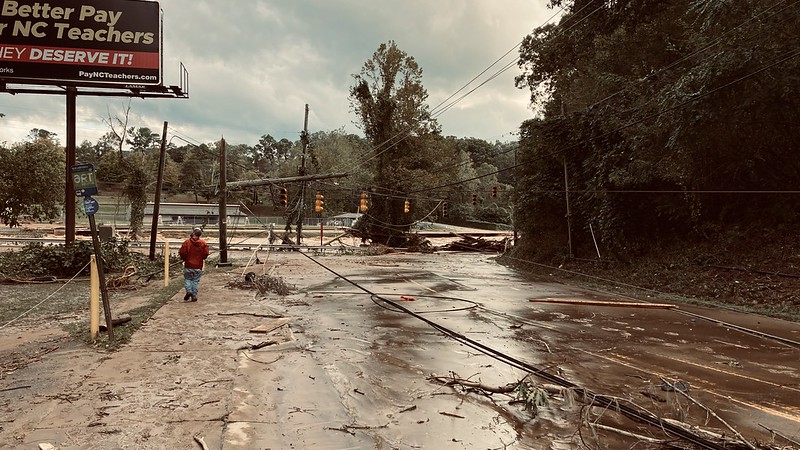
Jerry McNeely: This was kind of a double-dip storm, where we had an initial heavy front that dropped eight to 12 inches of rain immediately followed by the remnants of Hurricane Helene, which dropped in my area another 10 to 12 inches of rain – there were reports in the area of up to two feet of rain in a four-day period. Unlike coastal areas, where you’ve got the sandy soil that helps drain the water, up here, it’s red clay and rock, and so all the water runs off. At about 10 am on Friday morning, it hit critical mass just as the storm was ending, and we had a large mudslide at my home. It was two houses to my side and three houses that came off the side of the mountain.
One of the occupants was trapped in one home. I ran up there — I had to do something — and I worked for about 45 minutes. I got back far enough where I could see her toenails, because they were purple. There was a beam pinning her leg, I think.
About this time, three or four more Good Samaritan neighbors started to show up. And one, his name was Cheney. He crawled into the completely collapsed structure head first, with a headlamp and a rechargeable reciprocating saw, and climbed, I don’t know, 30 feet under the collapsed, flooded structure in a hole that a rabbit probably couldn’t have crawled through, and cut the beam supports that could have collapsed the building on his head, and was able to remove the lady from her structure. And we got her boxer out, her dog. We’re really happy. This is a morale booster. She had injuries to her leg, but they were not life-threatening, and she had large black eye. We finally got her evacuated about 18 hours later, and we kept her stable for the interim. Later on, we found out that the black eye was some sort of a head trauma. But she’s stable.
About the time that was wrapping up, we start hearing screams off the mountain, and there was an elderly man with a broken back. He had been tossed out of his mobile home. He’s on the far side of the mudslide, which is 75 yards wide, and the mud’s waist deep.
We work up there. By then he was nonresponsive, but he was alive, and we just — there was no help coming. But I took off down the mountain looking for any sort of policeman, any sort of paramedic who happened to have gotten across, because at this moment, I didn’t know the situation at the bottom of the mountain and how it was on the river. No one was found, and the man passed away on the mountain. One of my neighbors found his wife 200 yards further down the mountain. She had been killed instantly.
When I got down to look for the help at the bottom of the mountain, 150 yards from where the river should be, there’s the river and dozens and dozens and dozens of collapsed structures. They call it a river, but by anyone else’s standards, it’s a creek. You could walk across it in 12 to 15 large steps. And at this point in time, it was 300 yards wide of white water that went across the entire Swannanoa Valley. That valley was covered in mobile home parks, homes, churches, and a lot of that was just completely and totally erased.
I walked back up the hill, and I started with a small group, the guys who helped extract the person from the first house. We started divvying up efforts. We started door knocking. We started checking on neighbors. We started checking on homes on the mountain that have a lot of mud or a lot of water. We started introducing ourselves to the elderly who were up on the mountain. We found an elderly couple, the man is on oxygen, and we were making sure that his oxygen would last. They hadn’t had water in a full day, so we’re making delivery and food deliveries.
And that’s what we did. That’s the way we kept from going crazy, just helping our neighbors until really yesterday [October 2], when the full force of the outside world arrived, thousands and thousands of out-of-state sheriffs, deputies, paramedics, search and rescue teams, whitewater rescue teams, linemen. Yesterday I talked to two linemen from Quebec. They’d driven a power truck down here from Quebec, and they’re doing lineman work, and thanks so much to all these people. All these emergency personnel from out of state — I send my warmest to these folks.
Now they’ve kind of taken over those relief efforts and they’ve evacuated all our people at risk.
MS: The guy who was on oxygen, he’s been evacuated?
JM: Yes. He fought it tooth and nail. Honestly, folks in the mountains of North Carolina are incredibly resilient people. My family’s been here since the 1700s, and a lot of these folks have, too. This isn’t their first natural disaster. Their families have been surviving hardship for 200 years. He was of a mindset that he would rather die on the mountain than leave his home.
MS: But he was running out of oxygen, right?
JM: He was. We had gotten a generator up to him, but he was having problems with the oxygen concentrator. A lot of these oxygen concentration machines that create breathable oxygen don’t work really well on generator power, because the power coming from a generator has surges and ebbs and flows to the current, so they don’t react well to that. But he’s out of the area now.
I started receiving texts and calls at this point. We had great cell service. My word is that the reason the cell service went out abruptly 48 hours later is because the cell tower had a backup power generator and it ran out of fuel, and it’s up on the mountain, and all the roads to it are cut off.
I was getting texts from all over the world, and [some of my contacts] and a few other Good Samaritans were able to brave the conditions to get up here, some of them to evacuate their relatives, and they brought the first couple car loads of supplies. They were crucial because that’s when the greatest need was here. In the first 48 hours especially, the biggest need was water, because we’re used in the mountains to losing our power, but losing your water service is uncommon. It’s unprecedented, really.
We’re on city water infrastructure. Above Black Mountain and Swannanoa are two reservoirs — the water supply for the city of Asheville. They flow off the Black Mountains, which are the largest mountains east of the Rockies in the United States. They’re the largest mountains in the eastern U.S. This water serves the rest of the county, and the mains were broken, so all the water’s gone.
MS: You could have evacuated, but you decided to stay. Why?
JM: I evacuated my wife and my son [to her parents’ house] when the roads were open. I stayed because we were at this point where we still had elderly folks on the mountain, we still had neighbors who couldn’t get down the hill to receive supplies.
So the team of me and other volunteers on the hill, we were the wellness people. We were the door knockers. We were the people looking out for our neighbors, and I couldn’t — my priority number one was keeping my family safe, and once I knew I’d taken care of that, priority number two moved on to helping my neighbors, because that was my way of keeping my mental health. That was my way of putting one foot in front of the other. To work so hard all day long that when your head hits the pillow that night, you didn’t have time to worry and think — you were fast asleep. And then the next morning, you had your hot cup of coffee to boost your spirits, and you went and did it again.
This is where I’m from. My family, my grandparents, my great-grandparents. I have mountains and rivers and streams and roads named after family members. My family’s been here from the first European settlers. This is home.
MS: What do you need from the rest of the world right now, long- and short-term?
JM: The things that we don’t need — let’s start with that. Now that the roads are open, we’re experiencing disaster tourism — me pulling into my driveway and seeing a dozen people taking pictures for their Instagram feed of people’s lives thrown out on the ground.
MS: Get out. Are you serious?
JM: Yes. Meanwhile, the roads getting clogged up with this are the same roads that lineman and emergency services are trying to use, and many of these roads have been washed out to the point that there’s only one lane of access. Disaster tourism here in the mountains is what we don’t need.
Once power is restored, that’s going to be a big deal. It’s easier to deal with no water when you can at least flip the light switch on. You can at least pour bottled water into your coffee maker and make a pot of coffee. You can at least keep your refrigerator running and keep perishable food.
MS: Because you can’t — you’re cooking over, what, fires and gas stoves?
JM: A 1960s Coleman stove that belonged to my father, that’s been on a million camping trips. Most neighbors have something, and if they don’t have something, their next-door neighbor does. There’s a lot of community potlucks where one person says, “Well, I’ve got some frozen hamburger,” and the next person says, “Well, I’ve got two onions,” and the next person says, “Well, I’ve got some bread.” And that goes a long way for morale, too.
I would also ask people to talk to local officials before they just leave with loads of supplies. Talk to the local authorities about where the need is and timeframes for arrivals — don’t just load it up and drive it up here and try to find a place to drop it off.
There are two churches in my neighborhood that would love to have the supplies, but their entire fellowship halls are full of mud and floodwater. Until we can clear these churches and other community centers, like the library, we don’t have a place to warehouse supplies. So, coordinate with local leaders first.
As soon as the major highways happened, a floodgate of tractor trailer trucks showed up, full of water. But here’s the thing: with outages maybe lasting months, what we’re afraid of is, we have a glut now, but as time goes on, the shipments are going to quit coming.
MS: What else would you want to tell the world? Because there’s a lot of attention right now, since the crisis just happened, but what happens next?
JM: That’s exactly what I want people to know. I want everybody to know that there’s going to be a long-lasting need. I’m a fly fishing guide. Our rivers, our ecosystems, are utter disasters. There may be a point where, in six months to a year, these things can recover, but it may not recover for five or 10 years, and when you’ve devoted your life to something for the last 25 years, it’s a difficult situation. Looking forward, you don’t know — what’s your path now? And a lot of people are feeling that way.
The largest employer in our area is tourism. All these people work in hotels and restaurants and bars and tourist industries, and of course you’ve got tradesmen also, but they’re unemployed until these places get water. Hotels, restaurants — all these things can’t open without water. So I think we’re going to transition from a time when people are needing food because the grocery stores aren’t open to a time when people need food because they don’t have income.
If I had to send a message out to everybody, it would be: please don’t have a short, passionate outpouring of love for our community. Know that these needs are going to exist well into the future.
MS: In terms of you thinking about the future, as people are assessing damage to their homes and their belongings and thinking about work, I know stress is one of the biggest health impacts of a crisis like this. How will people hold up?
JM: There’s going to be consequences on down the road, health consequences, economic consequences. There was already an existing need for expanded mental health services in western North Carolina, and this is just going to put more burden on an already struggling system.
When [a friend] brought up the first load of supplies, I said, “I need a couple bottles of alcohol, and I need a carton of cigarettes — I don’t smoke — and I need some chewing tobacco.” Going through a disaster is bad enough, but the creature comforts — that hot cup of coffee or that cocktail at the end of the day — is an important part of your mental health, and it also draws the community together.
MS: How do you know this stuff?
JM: Man, I’m human. We all know this stuff.
MS: Oh, I don’t know. I don’t think if I was running low on water, I would think, “what I need is a pack of cigarettes.” But that makes a lot of sense. You need to feel a little normalcy.
JM: Can you imagine if your house was flooded, it’s full of mud, you don’t have power, you don’t have water, you don’t have any of these things. And then on top of it, you’re waking up without your coffee? It just makes it even harder. That’s one of the reasons that rolling out of the bed is easy, because you’re looking forward to those types of things. I’m the morale officer up here, man, and we’re just trying to put one foot in front of the other.
I don’t really know what’s next. I really don’t know what’s next. The other day, I was staring at the mud flow and all these broken homes and broken lives, and [a woman standing near me who is from out of state] said, “They’ll never rebuild this.”
And I looked at her, and I just smiled, and I said, “Man, the people of western North Carolina are resilient, and we’ve been hanging on these mountains like fleas on a dog’s back for over 200 years. And if you think a little flood is going to keep us from rebuilding this community, then you don’t know much about the community.”


Leave a Reply