The Trump administration is bypassing scientific evidence and procedure to change vaccine rules.
Last week, three top U.S. health officials made an unusual announcement about Covid vaccines.
They said they would remove the recommendation for Covid vaccination from the childhood immunization schedule, and would also cease recommending it for pregnant people.
The first reason it was unusual was the people who announced it:
- Robert F. Kennedy Jr., head of Health and Human Services (HHS)
- Marty Makary, head of the Food and Drug Administration (FDA)
- Jay Bhattacharya, the director of the National Institutes of Health (NIH)
Notably, no one from the Centers for Disease Control and Prevention (CDC) was there. That’s strange because the CDC is the agency that actually makes recommendations like these — not HHS, FDA, or NIH.
FDA may approve or authorize new medications and therapeutics like vaccines, but the CDC is the one who tells the public who should take them.
The NIH has no role in regulating vaccines.
The second weird part: The announcement was posted in a video on X (formerly Twitter). Suffice to say, that is not the usual recommendation process.
But then, somehow, the story got even more unusual.
Not a Doctor is 100% free. Sign up now for more updates on health, science, and technology.
On Friday, the CDC appeared to contradict that announcement by keeping Covid vaccines as a routine immunization for children – though the agency now says health providers “may” recommend the vaccine, instead of saying they “should” recommend it.
(They did remove the recommendation for pregnant people, even though pregnant people have much higher risks of illness, death and pregnancy complications with Covid, and even though Makary himself argued a few days earlier that pregnant people were at elevated risk and needed shots.)
Now, an official overseeing the CDC’s vaccine recommendations has resigned. I will be watching carefully to see whether the routine childhood recommendations change yet again.
Got tips or ideas for what I should cover next? Get in touch via email (melodyaschreiber@gmail.com) or Signal (melodyschreiber.06).
In all of the planned and announced changes on vaccines, there’s a group of people who feel particularly “enraged and betrayed”: the parents who enrolled their children in the Covid vaccine clinical trials.
They clamored to be enrolled so they could protect their children and children all over the world. But it would be unethical and probably impossible to conduct those trials again, they told me in an article for the Guardian this week.
“To think that they would subject anyone, let alone children, to potentially getting the placebo in a trial where we know that the control is already so beneficial for health, just seems highly unethical and really disturbing,” said Laura Labarre, a parent in Oregon.
“A new trial today would not add anything we don’t already know,” said Sophia Bessias, a parent in North Carolina. “It would feel like actually participating in a project of undermining the existing evidence, rather than contributing new evidence.”
–A ‘war on children’: as US changes Covid vaccine rules, parents of trial volunteers push back, The Guardian
I hope you’ll spend some time with that story; it was fascinating and illuminating to report.
The FDA also recently approved the Covid vaccine produced by Novavax only for people over the age of 12 with health vulnerabilities, in a change from Novavax’s emergency use authorization for anyone over the age of 12.
Similarly, the FDA approved the next-generation Covid vaccine from Moderna, which trials show works even better than the original — but FDA approved this new shot only for adults aged 65 and up, and for people aged 12 to 64 with health conditions putting them at higher risk.
That seems to be the direction the FDA is moving with all Covid vaccines.
The FDA further announced new requirements for mRNA Covid vaccine makers Pfizer and Moderna to add an additional warning label about the risks of myocarditis, or heart inflammation.
The FDA cited data from health systems indicating 8 in a million people develop the condition after vaccination. The FDA did not make this research public, so there are still lots of questions about the validity of this claim.
One question I have: The FDA said the myocarditis data were pulled from healthcare visits. But how did they disambiguate between myocarditis from vaccination, and myocarditis from Covid infection?
If you’re just looking at data from health visits, you would miss Covid cases where people perhaps didn’t feel the need to visit their doctors or even get tested. That means you might mistake myocarditis from vaccines when in fact they came from Covid cases that otherwise didn’t seem severe — which definitely happens.
And even if the 8 in one million figure is true, the risk of myocarditis from Covid itself is significantly greater: 0.21 in 1,000, which equals about one in 5,000 people, or about 210 in a million people. That’s 26 times worse.
These regulatory changes aren’t just concerning because they make it harder to access vaccines. Without sharing data for the restrictions or the warning, they risk spreading misinformation about the risks of vaccines compared to the risks of getting sick.
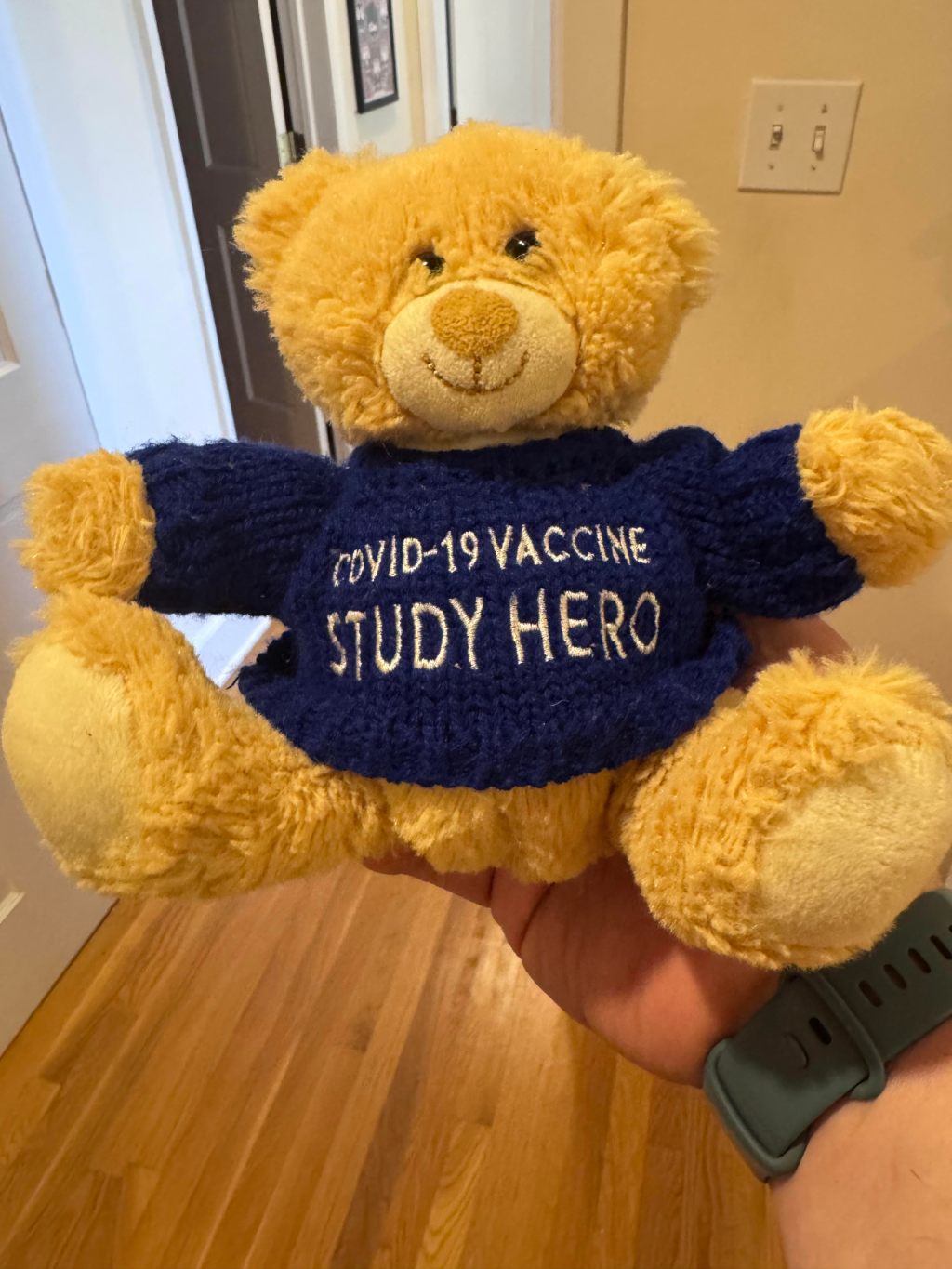
Top image: A stuffed teddy bear with a sweater saying “Covid-19 Vaccine Study Hero,” given to Nick Giglia’s daughter. Photo: Nick Giglia
 Not a Doctor
Leave a comment