A resurgence of the deadliest infectious disease could be on the horizon. But increased funding could end it for good.
I wrote recently for the Guardian about TBFighters, a group of people who are trying to end tuberculosis. The entire piece was a delight to write; I really enjoyed meeting everyone I interviewed, and I’m excited to continue following their work.
For the story, I talked to John Green, the vlogger and author, about his newest book, Everything Is Tuberculosis. It was such an insightful conversation, I wished I could include more of it in the article, so I’m publishing it here.
He talked about what drew him to tuberculosis, why the deadly disease has largely flown under the radar, and how we can write a better story that will end TB once and for all.
Melody Schreiber: What motivated you, what made you curious about TB?
John Green: I think statistics matter. It matters that TB is the deadliest infectious disease in the world, and that 1.25 million people will die needlessly of it this year.
But what really moves us is human stories. And I think I fell in hate with TB because I met a boy with tuberculosis in Sierra Leone when I was visiting there with Partners In Health, and if I hadn’t met Henry, I probably wouldn’t have written this book.
MS: And that’s because you kind of connected with him — he reminded you of your son?
JG: He reminded me of my son. He has the same name as my son. He looked to be about the same age as my son, although I later learned that he was much older. He was just so stunted by malnutrition and tuberculosis that he appeared young.
I was astonished by everything I didn’t know.
And, also, I was astonished by everything I didn’t know. I’m always fascinated by my own ignorance. And even though I care a lot about global health, I had no idea that tuberculosis was still the deadliest infectious disease in the world. And so I came home and I started reading about TB and learning about TB. And, well, my wife often says that when I fall down a rabbit hole, I tend to stay down it.
MS: And then everything becomes TB.
JG: Everything became tuberculosis. Yeah, everything is about tuberculosis, and tuberculosis is about everything, she always says.
Not a Doctor is 100% free. Sign up now for more updates on health, science, and technology.
MS: You kind of have this army of followers, and you’ve mobilized them on this topic. Did you feel like, you know what, “I can make a difference, I can do this,” or was it just kind of like, “This is what I’m interested in, and we’ll see if people are along for the ride”?
JG: I think I’ve mobilized them, but they’ve also mobilized me, if that makes sense. It’s easy to see it as a one-way street, but really it’s much more bi-directional in terms of the way that our community works. They reflect the community’s values back to us and tell us what to be interested in. Sometimes, when I want to let go of something, they’re like, “No, we’re not ready. It’s not time.”
So they were the ones who developed a 100-page document about how we respond to the tuberculosis crisis, and I was the one reading it, not the other way around.
MS: But for most people, TB was probably not on their radar before you brought it up.
JG: That’s probably true. I think probably most people weren’t aware of tuberculosis, but when they became aware of it, they became very angry, like I did. It was very similar to my experience, actually, where I became aware of the scope of the problem and the needlessness of the problem, and then when I told other people about the scope of the problem and the needlessness of the problem, they shared my enthusiasm for trying to solve it.
I think probably most people weren’t aware of tuberculosis, but when they became aware of it, they became very angry, like I did.
MS: You mentioned the values of the community being reflected back to you — how would you describe those values?
JG: I think the basic value is that all human lives have equal value, and that we need to build better systems to reflect that reality.
MS: How did you get there from being a YA novelist?
JG: It’s not actually not that far away. My work as a novelist also attempts to bridge empathy gaps and also attempts to humanize the other, for lack of a better term. So it doesn’t feel that far away for me, but I definitely think that over the last 18 years of making YouTube videos with this community, I’ve been pulled by them toward more activism and advocacy. I used to believe that it was enough to try to bridge empathy gaps with fiction, and I still think that’s important work and work I want to do in the rest of my life, but I now understand that on its own, that’s not enough.
I used to believe that it was enough to try to bridge empathy gaps with fiction, and I still think that’s important work and work I want to do in the rest of my life, but I now understand that on its own, that’s not enough.
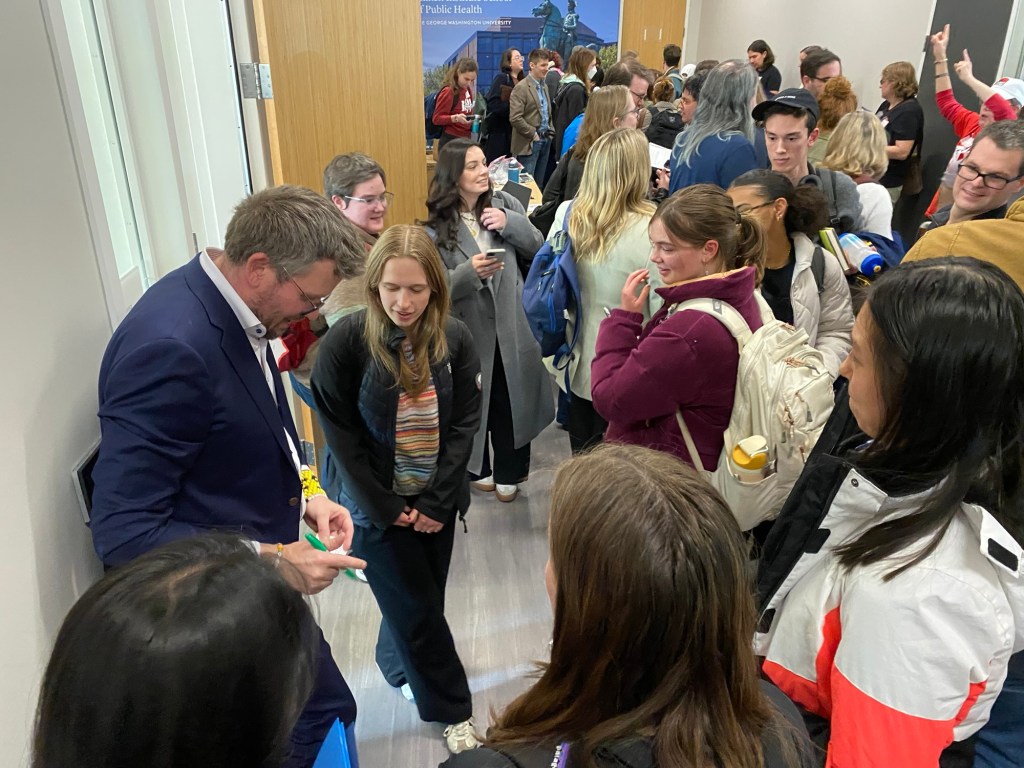
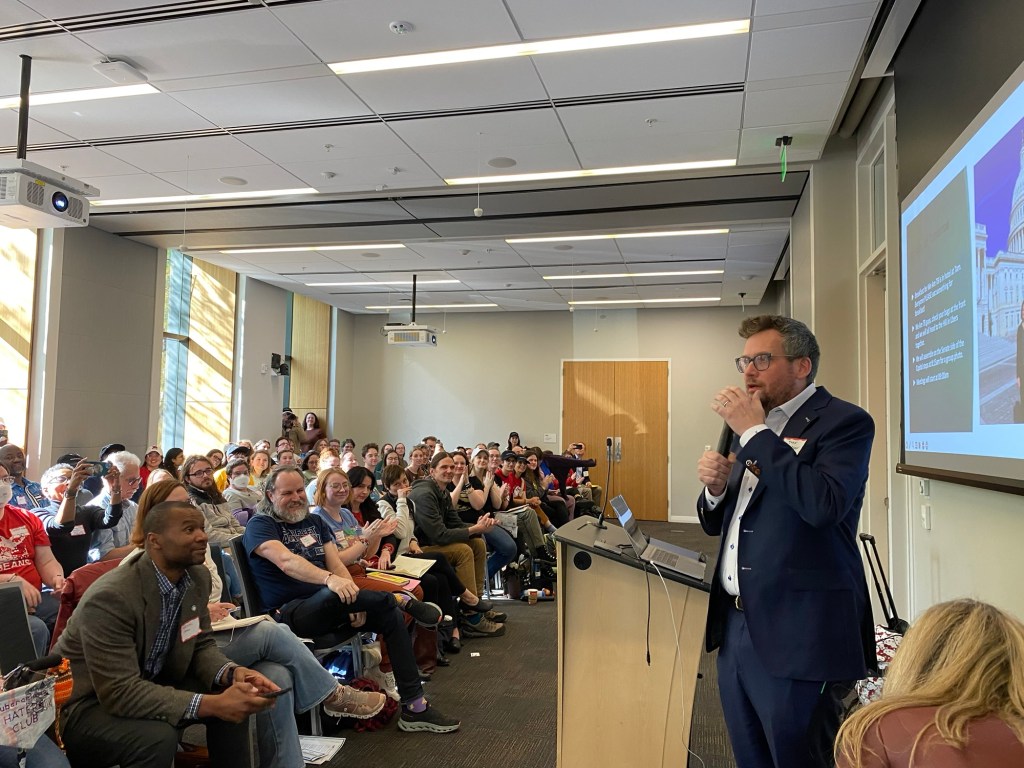
MS: How do you feel visiting Capitol Hill today?
JG: Nervous. It’s intimidating. You’re in the literal halls of power. It’s weird.
There’s lots of people trying to make lots of cases for lots of causes, and it’s really intense and strange and overwhelming. But I also know why I’m here, so that’s important.
MS: I saw a video of yours once that where you said, to paraphrase, “I don’t want to do anything else; I want to work on TB.” Do you still feel that way?
JG: I’m writing a novel now. I’ll write more novels in the future. But I love that this is the beginning of my life and this work, not the end of it. I look forward to doing that for the rest of my life.
MS: Has there been anything surprising to you on your book tour and during trainings like these?
JG: The vast majority of people in the US and the UK don’t know that tuberculosis is still a thing, even though it’s the deadliest infectious disease. So that’s a big part of the work, just getting attention. Because we solve the problems we pay attention to, and we don’t solve the problems we don’t pay attention to. And one of the reasons we haven’t solved the TB crisis is that traditionally, it’s just had a great shortage of attention on it.
We solve the problems we pay attention to, and we don’t solve the problems we don’t pay attention to.
MS: Why? Because of inequality?
JG: I think some of it is that the people who have access to megaphones are not likely to live with TB. I think some of it is that tuberculosis itself is a weird disease.
Even back in 1882, Robert Koch felt like he had to make the case for tuberculosis when he was publishing his paper about how TB was caused by this mycobacterium. I’m paraphrasing, but he was like, “I know we’re more afraid of cholera and plague and the like, but actually, tuberculosis is a much bigger deal.” And I feel like 145 years later, we’re still having to make that case to people.

MS: Before all of these cuts to international aid, you were working on a program in the Philippines that could’ve served as a model for ending TB. Now you’re trying to claw that funding back. What’s that shift been like for you?
JG: It’s been hard. It’s devastating for people who live with tuberculosis to experience these cuts, because we know that hundreds of thousands of people have seen their treatments interrupted. We know that those people are much more likely to develop drug-resistant tuberculosis now, and and we all know how scary that is. So it’s really devastating, and it’s been heartbreaking to watch it all unfold.
The easy response to it, and the tempting response, for me, is despair, but I think that’s the incorrect response. I think we have to respond to it with the belief that this isn’t permanent. This doesn’t have to be the end of the story. This can be the middle of the story, and together we can write a better end.
I really believe that we could see the end of it. That’s my dream.
If you enjoyed this interview, please share on social media or forward to a friend!
 Not a Doctor
Leave a comment